How Desync Works on Roblox
Introduction
Desynchronization (Desync) is a technique used to decouple your client-side position from the server-side position. This manipulation of state is highly effective for bypassing game security, depending on how the developer handles data.
The Three Tiers of Desync
Desync’s utility is defined by the game’s architecture:
Client-Authoritative Systems * Logic: The client registers damage directly (“I hit Player X”).
- Exploit: CFrame Desync. By offsetting the server position (e.g.,
Position * CFrame.new(0, 10000, 0)), you remain safe while your client interactions stay valid, this doesn’t necessarily grant invincibility, especially against other cheaters, but to legit players, it can.
- Exploit: CFrame Desync. By offsetting the server position (e.g.,
Server-Authoritative Systems * Logic: The client sends inputs (“I pressed Mouse1”), and the server calculates the result.
- Exploit: Network Desync. This breaks character replication, granting the cheater invisibility. Other players can still hit the server position, but they have no visual indicator of where the cheater actually is.
Hybrid Validation (Most Common) * Logic: Client registers damage, but the server validates it (“I hit X from Y distance”).
- Exploit: Network Desync. This is the most disruptive form. Because the client and server positions match, but the replicated character position does not, the server often flags legitimate attempts to hit the cheater as “invalid magnitude” or “hitbox expansion.”
- Result: The cheater achieves Invisibility + Invincibility, and may even trick the server into banning innocent players.
Exploiting CFrame Desync
CFrame desync is the “brute force” method. It involves manually manipulating the coordinate frame of the HumanoidRootPart in a way that the client perceives movement correctly, but the server receives a static or wildly different coordinate. Usually this is done by sending a CFrame update before the Heartbeat step of the Rendering Pipeline, then immediately setting it back to the cheater’s original position. This is pretty simple, but not very useful.
Scroll down to Further Reading for an excellent post by shusha on x64.gg (Roblox CFrame Desync)
Exploiting Network/Physics Desync
This method is more sophisticated, relying on FastFlags and HiddenProperties.
- FastFlags: Hidden toggles used by Roblox to enable/disable engine features (often for A/B testing).
- HiddenProperties: Instance properties not documented in the standard API, such as
NetworkIsSleeping.
Finding these requires dumping the [Roblox Studio Binary] and searching for strings, and testing whether or not the FFlag exists using a script executor because the flags in the dump will not be same as it when the game is running. For instance, a flag like FlagNextGenReplicatorEnabledRead might be enumerated internally as NextGenReplicatorEnabledRead3.
Note: Much of this is public knowledge [mirror] if you know where to look. If Roblox wanted to patch this, they could simply check if a client is reporting that
NextGenReplicatorEnabledWriteis enabled and issue a ban, especially because the server knows whether or not the feature is enabled.
I asked around and actually found a more concrete method of finding ALL fast flags, and its to use one of the free services most externals outsource to for their offsets: https://rbxoffsets.xyz/ conveniently, they also offer FFlags on their github, but they don’t offer hidden properties. P.S. I THINK they’re the same service.
Why NextGenReplicator?
NextGenReplicator is part of Roblox’s Server Authority Beta. It changes how clients replicate to the server, my theory is that the server “bounces” some metadata between clients, such as NextGenReplicatorEnabledWrite, so when another client reads the cheater’s metadata, it forces the client to wait for the server to the position (when the server has network ownership).
Naturally this “wait” breaks the legitimate client’s rendering of the cheater, because it relies on the last known server authoritative position that was given from the server.
Cheaters will have to reload their character, as this effect only starts when the character sends their first packet to the server saying “I rely on your authority”
The Code: A Universal Desync Script
If you’ve read through the yap above, here is my desync implementation logic, the CFrame logic isn’t mine, but the Replicator related is: desync.lua
Use Home to toggle UI, Arrow keys/Enter to navigate, and End to unload completely.
What can you do as a Roblox developer?
Don’t wait for the official Server Authority update to finish rolling out. You can implement safeguards now.
1. Countering CFrame Desync
On the client, connect to the HumanoidRootPart:GetPropertyChangedSignal("CFrame") signal.
- Logic: This signal only fires when the CFrame is deliberately set via script (client or server), not during standard WASD movement (which might be counter intuitive, now that I think about it). If it fires unexpectedly, alert the server.
2. Countering Network Desync (The “Voting” Method)
I propose a peer-validation system where clients “vote” on a player’s true position.
Client-side Logic:
-- Every frame, tell the server where you see everyone else
while true do
    local package = {}
    for _, player in Players:GetPlayers() do
        package[player] = ObservePosition(player)
    end
    Remote:FireServer(package)
    task.wait()
end
Server-side Logic: The server compares these observations against its own internal state. If a threshold of players see a target at a position that disagrees with the server’s state, suspicion rises.
-- Simplified suspicion logic
function Remote.OnServerEvent(observer, package)
    for targetId, observedPos in package do
        if (observedPos - ServerPosition(targetId)).Magnitude > MaxDistance then
            MismatchCount[targetId] += 1
        end
        ObserverCount[targetId] += 1

        -- If 2/3 of observers disagree with the server, flag it
        if ObserverCount[targetId] >= MinObservers then
            if MismatchCount[targetId] / ObserverCount[targetId] > MajorityThreshold then
                Suspicion[targetId] += 1
            end
        end
    end
endWarning: This is vulnerable to “Sybil attacks” (multiple malicious clients voting to kick an innocent player). Use this only in high-population servers where the majority is likely legitimate, also there may be problems with ping, as higher ping can make even more mismatches etc.
Other than this, I imagine that Roblox itself will have to patch the use of these fastflags, or intensely obfuscate it to the point where people will scam people for desync methods like this.
Afterwords
Now that we established we can break how other clients view us, and how we can offset our server position from our client position, it’s probably entirely possible to create complete “legit” desync by figuring out what other players see, what the server sees, and what we see (client).
I’ve attached my desync code to my github, give me a star and I’ll release more secrets or publish guides on how to crack scripts, etc.
Other notable FastFlags:
LargeReplicatorEnabled9
GameNetDontSendRedundantNumTimes
MaxTimestepMultiplierAcceleration
InterpolationFrameVelocityThresholdMillionth
CheckPVDifferencesForInterpolationMinRotVelThresholdRadsPerSecHundredth
TimestepArbiterVelocityCriteriaThresholdTwoDt
GameNetPVHeaderLinearVelocityZeroCutoffExponent
TimestepArbiterHumanoidTurningVelThreshold
LargeReplicatorSerializeWrite4
SimExplicitlyCappedTimestepMultiplier
InterpolationFrameRotVelocityThresholdMillionth
ServerMaxBandwith
LargeReplicatorSerializeRead3
GameNetDontSendRedundantDeltaPositionMillionth
PhysicsSenderMaxBandwidthBps
CheckPVCachedVelThresholdPercent
NextGenReplicatorEnabledWrite4
LargeReplicatorWrite5
MaxMissedWorldStepsRemembered
StreamJobNOUVolumeCap
CheckPVLinearVelocityIntegrateVsDeltaPositionThresholdPercent
DisableDPIScale
WorldStepMax
InterpolationFramePositionThresholdMillionth
MaxAcceptableUpdateDelay
TimestepArbiterOmegaThou
CheckPVCachedRotVelThresholdPercent
StreamJobNOUVolumeLengthCap
S2PhysicsSenderRate
MaxTimestepMultiplierBuoyancy
SimOwnedNOUCountThresholdMillionth
ReplicationFocusNouExtentsSizeCutoffForPauseStuds
LargeReplicatorRead5
CheckPVDifferencesForInterpolationMinVelThresholdStudsPerSecHundredth
MaxDataPacketPerSend
MaxTimestepMultiplierContstraint
DebugSendDistInSteps
GameNetPVHeaderRotationalVelocityZeroCutoffExponent
AngularVelocityLimit
Further Reading
For those interested in the history of the exploit:
https://www.youtube.com/watch?v=92Oydz7zsVU (This uses a different desync method than the one I post about, I don’t know how it works, likely
GameNetLocalSpaceMaxSendIndex, https://github.com/stxzqv/Ultimate-fflag-Pack)Roblox CFrame Desync (x64.gg)
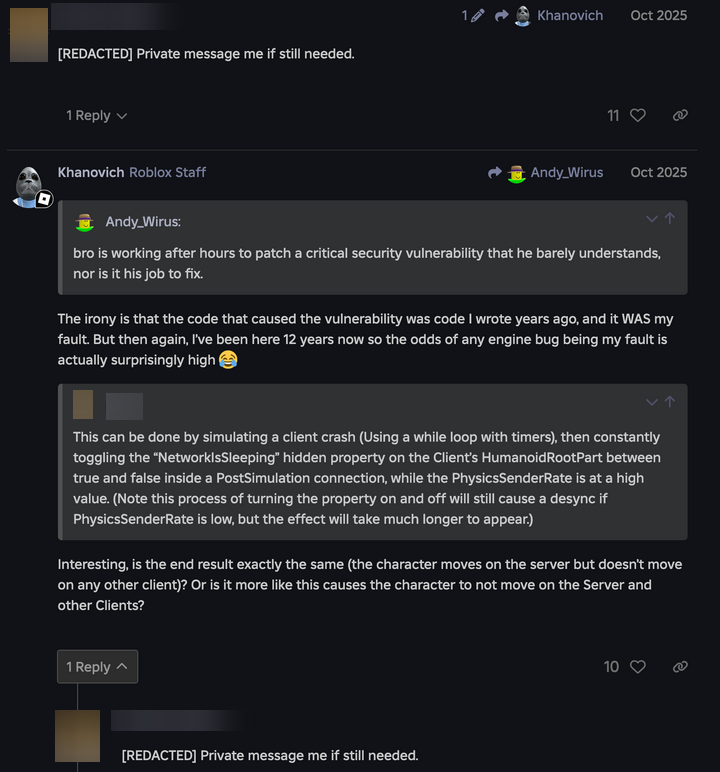
Developer Report on Desync Spreading (DevForum)
Roblox Physics/Network Desync (v3rm.net)
Notice how often these methods are redacted or hidden to prevent patches